Questions behind the search
What the reader is trying to decide
- What work happens before anyone builds the AI system?
- Which deliverables should be included in an implementation proposal?
- How are data, integrations, permissions, and approvals designed?
- What testing is required before production?
- Who trains the team and owns change management?
- What happens after launch when models, software, or business rules change?
- Which decisions should remain human?
An AI implementation for a small business includes discovery, workflow mapping, data and system design, authority boundaries, integration, testing, training, controlled launch, monitoring, maintenance, backup, and recovery. The model is only one component. The actual deliverable is a dependable way of working: people know what the system can do, records remain authoritative, risky actions require approval, failures have a path, and someone remains responsible after production.
If a proposal contains only tool setup, prompts, and a few demonstrations, it is not yet a complete implementation. A credible AI implementation process covers both technical delivery and operating responsibility; small business AI integration is not finished when an API first returns an answer. NIST describes AI risk management through four connected functions—govern, map, measure, and manage—and says testing should occur before deployment and regularly in operation.[1] That structure translates well to practical business work: set responsibility, understand the context, test behavior, then operate and improve it.
The AI implementation process versus a tool setup
A tool gives capability. An implementation assigns that capability a job, context, access, boundaries, measures, and an operating owner. A general assistant may summarize text; a production workflow must also know which text it may read, which version is current, where a draft goes, who approves it, what happens when facts conflict, and how the business recovers when a dependency fails.
That is why an AI implementation for a small business is partly software and partly operating design. Good AI automation implementation work makes the difficult boundaries visible before the interface makes the workflow feel easy. The visible interface may be simple because the difficult work has been handled underneath: identity, permissions, source records, integration reliability, logging, quality checks, and escalation.
Phase 1: qualification and problem definition
The first task is deciding whether AI is appropriate. A responsible qualification conversation identifies the business problem, urgency, current tools, affected people, volume, consequences of error, and a useful outcome. It also identifies simpler alternatives. A database rule, form validation, template, scheduled report, or ordinary automation may be cheaper and more predictable than a generative model.
A useful problem statement is specific: “Reduce the time between a new service inquiry and an owner-approved response while preserving the CRM as the authoritative record.” It is not “use AI for sales.” The first version should name:
- the workflow owner;
- the current start and finish;
- the recurring friction;
- the business consequence;
- the people and systems involved;
- the initial success measure;
- the actions that are explicitly out of scope.
Ordisyn begins with this operating question across its AI automation solutions, because implementing the wrong task well still produces the wrong result.
Phase 2: workflow audit and baseline
The audit follows real cases, not an idealized procedure. Operators often know shortcuts, exceptions, and informal handoffs that never reached a policy document. The implementation team samples normal work, late work, missing information, duplicated requests, sensitive cases, and failures. It records where people retype data, wait for a decision, search for context, or reconcile conflicting systems.
The baseline should be light but credible: current handling time, response delay, backlog, rework, unresolved exceptions, or completion rate. It does not need false precision. It does need a pre-change reference. Without one, a team can tell that a demo feels fast but cannot tell whether the production workflow improved.
For a local engagement, the AI automation service in Coeur d’Alene describes an audit-to-implementation path rather than a generic software sale.
Phase 3 of small business AI integration: data and authoritative records
An AI implementation for a small business must state what information the system may use and where truth lives. A CRM may own contact status, accounting software may own invoices, a scheduling system may own appointments, and a controlled policy folder may own procedures. The AI should not quietly create a second, conflicting source of truth.
Data work can include field mapping, document selection, cleanup, duplicate handling, retention decisions, access groups, and source links. It should collect the minimum useful context. The FTC’s business security guidance recommends keeping only personal information needed for business and protecting what is retained.[3] “Connect everything” is therefore not a responsible default.
For knowledge retrieval, documents need owners, dates, and status. Drafts, superseded policies, and informal notes should not be presented as current instruction. Outputs should cite or link to source material where practical, and the system should be allowed to say that the evidence is missing.
Phase 4: architecture and integration design
This phase chooses the minimum responsible components: model service or local model, orchestration, business applications, identity, storage, queues, logs, monitoring, and backup. It also decides where processing occurs and which vendors receive data. Private local AI and cloud AI are architectural choices, not moral labels; many useful systems are hybrid.
Integrations should use supported interfaces when possible. Small business AI integration also needs explicit retry and reconciliation behavior rather than assuming every connected service will respond once and correctly. The design must account for rate limits, timeouts, changed fields, expired credentials, duplicate events, and partial completion. If the system creates a task but fails before recording it, can a retry create two tasks? If an invoice is updated but the notification fails, which state is authoritative? These ordinary engineering questions often matter more than model cleverness.
The Ordisyn Foundation frames this layer as governed business context, permissions, approvals, safeguards, monitoring, backup, and recovery.
Phase 5: authority and human-approval boundaries
Observation is not permission to act. An implementation should separately define read, draft, recommend, create, update, send, delete, approve, pay, and administer. The named business owner—not the model—grants authority.
| Action class | Typical first-release boundary | Human responsibility |
|---|---|---|
| Read and summarize | Approved sources only | Verify consequential interpretation |
| Draft | Clearly labeled; no external send | Edit and approve |
| Create internal task | Reversible, logged, limited types | Handle exceptions and duplicates |
| Update record | Specific fields and validated values | Approve sensitive changes |
| External communication | Approval required at launch | Own identity, promise, and audience |
| Money, legal, people, safety | Decision remains human | Exercise qualified judgment |
| Permissions or credentials | No autonomous changes | Authorized administrator acts |
NIST’s governance guidance emphasizes clear human roles and responsibilities for AI oversight, and asks who will maintain, monitor, re-verify, and update the system after deployment.[2] Those names belong in the implementation record.
Phase 6: AI automation implementation and evaluation
The build can include prompts, deterministic rules, retrieval, model selection, structured outputs, validation, integrations, user interfaces, alerts, and logs. Good systems do not ask the model to solve every step. Fixed rules are better for fixed constraints; AI is useful where language, variation, or synthesis makes ordinary rules brittle.
Evaluation begins before production. This is the evidence-producing part of the AI implementation process, not an optional polish step. Create representative test cases from approved, safely handled examples. Include ordinary inputs and adversarial ones: missing fields, contradictory records, prompt injection inside a document, very long text, wrong language, duplicate requests, unsupported instructions, stale policies, and unauthorized users. Score facts, source use, routing, format, refusal, latency, and human correction.
NIST calls for quantitative, qualitative, or mixed methods to assess and monitor risk, including documented testing and performance assessment.[1] A practical small-business test set may be modest, but it should be repeatable. “It worked when we tried it” is not a release criterion.
Phase 7: security, privacy, and recovery
An AI implementation for a small business inherits the security duties of every connected system. Use individual identities, least privilege, multifactor authentication, protected secrets, supported software, logs, and an access-removal process. CISA recommends MFA, patching, and backups for small businesses and stresses testing partial and full restores.[4]
Recovery design answers: What continues manually? Which configuration and data are backed up? Who can restore them? How long can the workflow be unavailable? What happens to queued work? How do users know that results may be incomplete? Backups are not proven merely because a job reports success; restoration must be tested.
Privacy design identifies data categories, vendors, regions where relevant, retention, deletion, logging, and who can inspect prompts and outputs. Vendor terms and endpoint behavior should be checked for the exact service being implemented, not assumed from a consumer chatbot.
Phase 8: pilot, training, and change management
The first production-like release should have narrow users, narrow data, and narrow authority. Shadow mode is valuable: the system prepares a result while the current process continues, allowing comparison without immediate consequence. A pilot review decides whether to proceed, revise, reduce scope, or stop.
Training is operational, not promotional. Users need to know:
- what the system does and does not do;
- which sources it uses;
- how to verify a result;
- which actions require approval;
- how to recognize and report failure;
- what sensitive information must not be entered;
- how to use the manual fallback;
- who owns support and policy questions.
People should not be evaluated against an invisible algorithm or told to trust a result because it sounds confident. The workflow should make uncertainty and source evidence visible where possible.
Phase 9: production launch and managed operation
Launch is a transfer into ongoing responsibility. Monitoring should cover availability, integration errors, queues, unexpected volume, corrections, model or configuration changes, access events, and business measures. Alerts need an owner and an action; a dashboard nobody reviews is decoration.
Maintenance can include supported updates, credential rotation, model evaluation, prompt and rule changes, document refresh, incident triage, backup verification, and user guidance. Managed AI operations give those recurring duties a named home after the project team leaves. This is why managed AI operations are separate from the initial build. NIST explicitly treats monitoring and management as ongoing, not one-time work.[1]
What should be included in the proposal and handoff?
Use this AI implementation for a small business checklist when reviewing scope. It is also a practical AI automation implementation handoff list:
- Problem statement, workflow owner, baseline, and success measures
- In-scope and out-of-scope actions
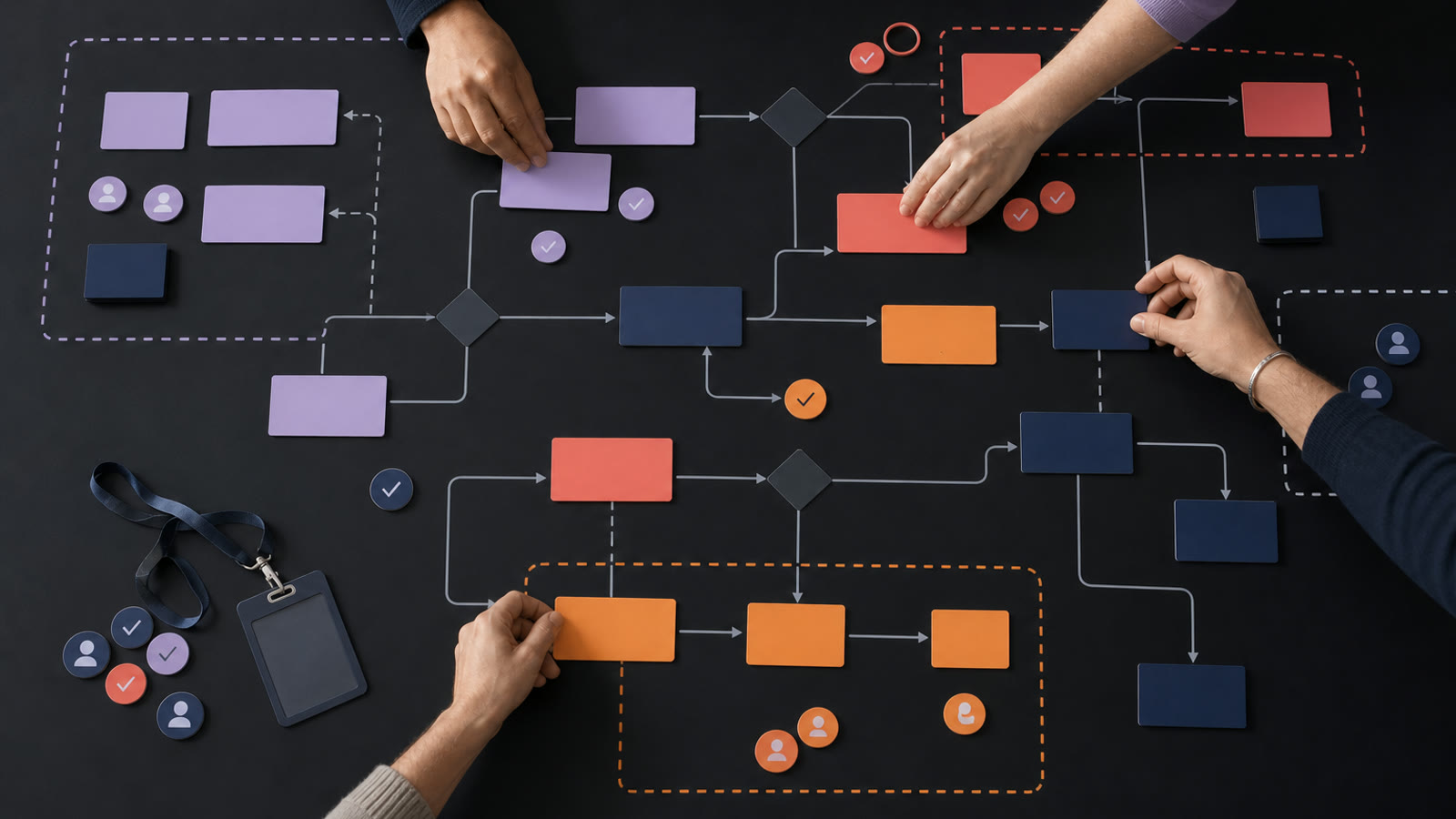
- Workflow map with normal and exception paths
- Authoritative systems and approved data sources
- Data minimization, retention, and vendor-routing decisions
- Architecture and integration list
- Roles, permissions, approval gates, and stop authority
- Test plan, test evidence, and go-live criteria
- Logging, monitoring, incident, backup, and recovery plan
- Pilot users, training, and manual fallback
- Documentation and ownership after launch
- Separate recurring vendor, hardware, and support costs
- Change-request and expansion process
Pricing should distinguish discovery, implementation, hardware, third-party usage, and ongoing care. Ordisyn publishes current starting points and boundaries on its AI automation pricing page.
Limitations and responsible boundaries
No implementation guarantees perfect accuracy, uninterrupted service, security, savings, or revenue. AI outputs can be wrong; source records can be wrong; vendors and models can change; integrations can fail; operators can misunderstand a result. Sensitive or regulated work may require legal, privacy, compliance, or security specialists beyond the implementation team.
An AI implementation for a small business should not transfer legal, financial, medical, employment, safety, or other consequential judgment to software. AI can organize evidence and prepare work, but an appropriately qualified person remains responsible for the decision and commitment.
FAQ: AI implementation for a small business
How long does an AI implementation take?
It depends on workflow clarity, access, data quality, integrations, testing, and risk. A narrow pilot can move faster than a multi-team operating system. A credible proposal should state phases and dependencies rather than promise a universal timeline.
Is custom model training required?
Often no. Many projects use an existing model with approved context, retrieval, rules, validation, and integrations. Fine-tuning is justified only when evaluation shows a stable need that simpler controls do not meet.
Who should own the project internally?
A business workflow owner with authority to define the process and accept or reject behavior. IT or a provider can own technical operation, but cannot invent business policy.
What is the minimum viable pilot?
One workflow, a representative test set, limited users, minimum access, human approval, logs, baseline measures, and a manual fallback.
What happens after launch?
The owner reviews performance and exceptions while the technical operator monitors, maintains, backs up, tests, and updates the installed capability. New authority or integrations should be separately approved.
Conclusion: managed AI operations complete the implementation
A durable AI implementation for a small business begins with the work and ends with accountable operation. Discovery, data, permissions, tests, training, monitoring, and recovery are not overhead around the “real AI.” They are what turn capability into a responsible business system.
Ordisyn, offered by Embyrs Ignite LLC dba Embyrs, is based in Coeur d’Alene and designs private-by-design systems that remain human-led for consequential work. To discuss a scoped implementation without sending sensitive information, contact Ordisyn or email sales@ordisyn.com.
Sources
A practical next step
Start with the work, the authority, and the failure path.
Ordisyn begins with the operating problem and defines the smallest responsible implementation before access expands.